Skip to main content
Advanced Search
Rimbunan: Pangkalan Data Pengajian Melayu
Browse Items
Browse Collections
Browse Exhibits
About
Collection Tree
Open menu
Close
Browse Items (19606 total)
Browse All
Browse by Tag
Search Items
Sort by:
Title
Creator
Date Added
Text
Akhbar
BERITA
Joseph Pulitzer:berusaha hingga kaya, membaca hingga buta
Tentang akhbar, Joseph Pulitzer pernah berkata: apa yang menghidupkan berita ialah tajuk yang menggemparkan, penulisan yang segar, keaslian cerita, gaya bahasa yang menimbulkan humour, kekuatan deskriptif, satira, tapi yang lebih penting, tiap berita mesti benar.
Journal of the Malayan Branch of Royal Asiatic Society
The Mao K'un with the Zheng he Voyages used a star charts instead of the ocean navigations. But there are mislabeled star chart title of navigational diagrams by Needham. Also there are some problems in identifying stars with sailors' and names'. Zheng aids to navigation but only approximate geographical coastal positions can be found.
Journal of the Malayan Branch of the Asiatic Society
The passage describes how early sailors used the Pole Star, Polaris or navigation before the 1470s. Because Polaris appeared nearly fixed in the sky, its altitude helped sailors estimates latitude, although it was not perfectly alighed with the North Pole. The text also explains that Polaris was less useful in Southeast Asia and the Indian Ocean., where sailors relied more on coastal navigation. Araba and Chinese navigators used simple tools such as the kamal and star plates to measure star height above the horizon fo guidance at sea.
Journal of the Malayan Branch of the Asiatic Society
The marine compass was an important tool for navigation because it showed direction at sea. However, a compass 'course' is different from a 'bearing". Early compasses ranged from simple magnetized needles floating in water to more advanced instruments. The Chinese were the first to invent the magnetic compass, and during the Ming dynasty they developed it further by mounting it on a detailed diving board.
Journal of the Malayan Branch of the Royal Asiatic Society
Instead of relying only on military force, it focused on cutting off support to the Malayan National Liberation Army by relocating rural populations into controlled New Villages. This prevented guerrillas from getting food and supplies while security forces maintauned pressure.
Journal of the Malayan Branch of the Royal Asiatic Society
The Panembahan lived on an island called Trusan, where the village of Gelaherang was located. This had been the capital. The river was navigable for small local boats, which could reach the town and anchor at a spot known as Lubuk Sauh.
Journal of the Malayan Branch of the Royal Asiatic Society
Evidence from the 1431 Chinese expedition demonstrates that sailors adapted flexibly to changing wind systems. Rather than strictly following a fixed directional cycle, fleets could travel both eastward and westward within the same monsoon season. For example, Chinese ship sailed from China to Java on the winter monsoon, then continued to Malacca during the southwest monsoon, and later crossed the Indian Ocean to Hormuz during the northeast monsoon. , returning again within that same seasonal patters.
Journal of the Malayan Branch of the Royal Asiatic Society
The passage explain that sailing routes were heavily influenced not just by wind direction but by seasonal weather conditions. Stormy monsoon periods often made certain coastal harbors in accessible, such as the east coast of the Malay peninsula during the musim tutup kuala and the west coast of India during the southwest monsoon. These environmental constrains shaped navigation strategies more than simplistic wind model suggests.
Journal of the Malayan Branch of the Royal Asiatic Society
The text correct the misconception that the southwest monsoon moves in a straightward diagonal path from Africa to Southeast Asia. In reality, it develops progressively, beginning near Aceh, then reaching Sri Lanka, and finally the west coast of India.
Journal of the Malayan Branch of the Royal Asiatic Society
The term navigation did not the originally mean precise position-finding as it does today. It referred broadly to guiding a ship across open waters., while pilotage described navigation near coastlines using visible landmarks.
Journal of the Malayan Branch of the Royal Asiatic Society
The development of modern navigation techniques began in Europe during the late 15th century, not the early 1420s as often misunderstood. Contrary to popular belief, Prince Henry the Navigater did not initiate advanced oceanic navigations for voyages to Asia. Rather, it was under king John ll of Portugal in the 1470s that significant progress occured. His directive aimed to improve navigation after Portuguese sailors crossed the equator in search of the legendary figure Prester John.
Journal of the Malayan Branch of the Royal Asiatic Society
Portuguese adapted and simplified earlier Arabic instruments such as quadrants and astrolabes. These tools were modified to measure the altura in degrees, making them more practical for sailors. Additionally, nautical almanacs that is derived from Arabic knowledge were introduced, incorporating solar data alongside stellar observations.
Journal of the Malayan branch of the Royal Asiatic Society
Navigation reminded far from precise. Mariners could not accurately determine their exact geographic position. The concept of locating a ship at the intersection of latitude and longitude was largely theoretical and confined to scholars. Longitude was especially difficult to measure and could only be estimated, while latitude was not fully conceptualized as it is today. Instead, sailors relied on measuring the altitude of stars, rather than understanding latitude as a coordinate systems.
Journal of the Malayan Branch of the Royal Asiatic Society
Even experienced navigators, including Arab seafarers known for their advanced techniques, did not use latitude in the modern sense. This reliance on celestial height measurements persisted for centuries, with some English sailors continuing the practice into the Victorian era.
Journal of the Malayan Branch of the Royal Asiatic Society
The marine charts from the early times were showing a recognizable Mediterranean and northwestern shoulder of Africa without latitude and longitude. Arabs used a chart that were inspired by Portuguese. The Mao K'un maps named a later compiler found in the Wu-pei chin were written with text, and are of no standard siza or orientation.
Journal of the Malayan Branch of the Royal Asiatic Society
Voyage routes ran in lines followed parallel to an irregular coastline and they provided the navigation with a direct picture of the coast but it was not possible to fix these. They are more like the straight line guides of the LondonUndergraund with pretty pictures.
Journal of the Malayan Branch of the Royal Asiatic Society
Sailing directions were recorded in East and West for both coasting and open sea voyages. For example, 5the knowledge of the various trade routes with directions and favorable winds, and description of the coastlines. Office are termed as Pilots after fitting their modern equivalents that include geographical descriptions and commercial information.
Journal of the Malayan Branch of the Royal Asiatic Society
There is no other instruments but Mao K'un maps for open ocean navigations. Star altitude were added for the first time when crossing the mouth of the bay of Bengal .
Journal of the Malayan Branch of the Royal Asiatic Society
The introduction explains how the Tun Abdul Razak Memorial presents Tun Abu Razak Hussein as a model national leader to support nation-building. using Benedict Anderson's theory, the passage argues that museums are used by governments to shape national identity and promote state-approved values, especially to younger generations.
Journal of the Malayan Branch of the Royal Asiatic Society
William Edward Maxwell was a toddler in 1847, and in1867, the colonies of the British which is Penang, Malacca, and Singapore were governed by India. And, the Crown Colony of the Straits Settlements was established. Then almost civil servats were recalled but Maxwell was not maybe due to the influence of his father.
Journal of the Malayan Branch of the Royal Asiatic Society
William Maxwell studies land tenure system since the influence of British in the Malay states grew and proper system of registration of land titles and boundaries was needed to create revenue from the occupied land. And he bring a new uniform known as Burma and simple scheme for the registration of titles known as the Torrens system.
Journal of the Malayan branch of the Royal Asiatic Society
About Sir B.P. Maxwell and His contribution. Sir Peter Benson Maxwell( W.E. Maxwell's father) went to the Penang to take a position of Supreme Court Judge. After several years later, he published a book known as" Our Malay Conquests", epitomizing a polemic based on Julius Caesaqr's famous quote"venimus, vidimus, vicimus". His criticism was levelled at the conduct of the British in not respecting Malay customs.
Journal of the Malayan Branch of the Royal Asiatic Society
This passage describes the early connection between Frank Swettenham and William Edward Maxwell after Swettenham arrived in Singapore in 1871. Although the exact date of their first meeting is unclear, they likely met through Maxwell's government appointments and social events. As a new colonial cadet without strong political connections, Swettenham focused on learning Malay under his teacher Haji Mohamed Said. His quick success in passing the Malay examination helped establish his reputation and supported his later rise in the social administration.
Journal of the Malayan Branch of the Royal Asiatic Society
This passage shows that Frank Swettenham wanted to protect his personal legacy in British Malaya. He strongly supported the Federation of the Malay States and feared people would forget his achievements. his Malayan artefacts were later kept in the national Museum. The passage also explains how aolonial names such as Port Swettenham and Maxwell Hill were later changed after independance.
Journal of the Malayan Branch of the Royal Asiatic Society
This passage explains the "mimetic model" or premodern Southeast Asian states. Power was organized though a hierarch where smaller rulers imitated stronger kings to gain prestige and authority. Based on Rene Girard's idea of mimesis, rulers desired power by copying superior models, which often created rivalry and conflict. This system is described as the "mandala system", where a central kingdom controlled surrounding towns in expanding circles of influence and imitation.
Journal of the Malayan Branch of the Royal Asiatic Society
This passage shows that in premodern Southeast Asia, relationship between kings and power centers could be either hierarchical cases, a superior king ruled over inferior ones, maintaining order. In rivalrous cases, rulers of similar status completed for dominance, which could lead to war, such as conflicts between Pegu and Ayutthaya. Even lesser rules might challenge stronger ones or negotiate power under certain conditions. The passage also introduces the idea that political differences between groups but also by the need to distinguish oneself from similar group, creating "fractured resemblances".
Journal of the Malayan Branch of the Royal Asisatic Society
The English ship captains sailed in Asian water had been sailing in the region for twelve years such as from Bengal to Batavia it called Penang, via the stag called at Malacca.
Journal of the Malaysian Branch of the Royal Asiatic Society
The bridge plan was a strategy during the Malayan Emergency, introduced by Sir Harold Briggs in 1950 to defeat the communist insurgency.
Journal of the Malaysian Branch of the Royal Asiatic Society
Oliver Lyttelton's Reccomendation were made during the Malayan Emergency after his visit to Malaya in 1951 to assess the worsening security situation. He found that the Home Guard system was poorly organized and divided between Malay kampong guards and Chinese New Villagfe guards, with weak coordination and unequal development.
Journal of the Malaysian Branch of the Royal Asiatic Society
common misunderstandings about monsoon wind patterns and their role in historical maritime trade across the Indian ocean and Southeast Asia. While it is often believed that ships followed a simple one-way seasonal pattern and returing west with the southwest monsoon. However the reality was more complex.
jpm, jabatan induk yang unik
Membincangkan mengenai pembukaan Jabatan Pengajian Melayu sebagai jabatan induk di Universiti Malaya
Text
JPN benarkan nama anak-bapa angkat digabungkan
Text
JPN benarkan nama anak-bapa angkat digabungkan
Text
banjir
spm
JPN Kelantan sedia tempatkan calon SPM di asrama
Jabatan Pendidikan Negeri(JPN) Kelantan bersedia menempatkan calon Sijil Pelajaran Malaysia (SPM) di asrama sekolah sekiranya berlaku banjir sepanjang tempoh peperiksaan tersebut.
Text
JPN selesai kes wanita didakwa sudah kahwin
Juadah istimewa Syawal
Masmouta dikaitkan dengan warisan dan sejarah bandar-bandar Iraq seperti Basra yang terletak di kawasan pantai teuk di kawasan selatan Iraq.
Still Image
Makanan/Masakan Melayu
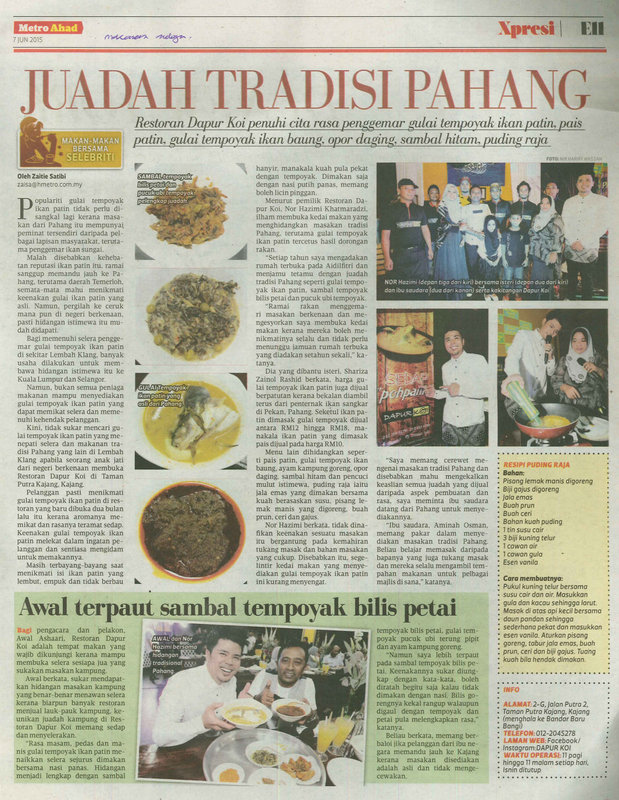
Juadah tradisi Pahang
Content
Juadah tradisi Pahang
ekonomi melayu
Jual 'Nasi Lemak Janda' 1000 bungkus sehari
Sebuah warung di Taman Malim Jaya di sini mengambil nama-nama tempat di negeri ini bagi membezakan variasi rasa Nasi Lemak Janda yang menjadi rebutan pelanggan setiap pagi.
Jual 20 jenis inti apam balik
Seorang peniaga telah menarik pelanggan dengan menyediakan pelbagai jenis inti apam balik. Kebiasaannya apam balik hanya berintikan jagung dan kacang namun, pengubahsuai ini telah mendapat sambutan ramai.
Text
ikan
ramadan
Jual 200 ekor ikan salai patin, talapia sehari sepanjang Ramadan
Ikan salai patin dan talapia menjadi pilihan pembeli sehingga berjaya dijual 2000 ekor sehari
Text
buah
makanan
Jual 30 tan durian dalam masa 10 hari
Sambutan buah tempatan, durian masih tinggi dan mendapatkan perhatian rakyat negara walaupun ura-ura kenaikan raja buah itu pada tahun semasa.
Text
makanan
Makanan/Masakan Melayu
Jual 400 keping roti goreng setiap hari
Ramuan tepung istimewa menjadikan menu itu laris dijual di Bazar Ramadan Lurah Semantan
ekonomi melayu
Jual 600 bungkus nasi lemak sehari
Setiap hari, hampir 600 bungkus nasi lemak daun pisang disediakan Otai Legend yang terletak di Taman Tun Sardon, Gelugor, Pulau Pinang, habis dalam masa beberapa jam.
Text
Makanan/Masakan Melayu
Jual 700 biji roti John sehari di bulan Ramadan
Antara makanan untuk juadah berbuka puasa yang paing popular adalah roti John yang kebiasaannya mudah didapati di bazar Ramadan
Text
bazar
berbuka puasa
...5 more
Jual 700 biji roti John sehari di bulan Ramadan
Antara makanan untuk juadah berbuka puasa paling popular adalah roti John yang kebiasaannya mudah didapati di bazar Ramadan.
Text
Makanan/Masakan Melayu
Jual 9,000 keping akok bantu kukuhkan kewangan keluarga
Seorang suri rumah dari Projek Perumahan Raykat (PPR) Gua Musang memanfaatkan masa luangnya untuk menghasilkan 9,000 kuih akok sepanjang Ramadan untuk mengukuhkan kewangannya.
ekonomi melayu
Jual biskut bantu suami hilang kerja
Menurut Syanizah Idrus, 34, walaupun suaminya hilang punca rezeki, selaku isteri dia tidak patah semangat sebaliknya tampil membuat biskut serta pelbagai jenis kek dan dijual secara dalam talian bagi meneruskan kelangsungan hidup.
Text
makanan
Makanan/Masakan Melayu
Jual cencaru sumbat bakar RM1.50 seekor
Muhamad Shafian menunjukkan ikan cencaru sumbat bakar berempah yang mendapat sambutan daripada orang ramai.
Text
Puasa
ramadan
Jual ikan selayang 50 sen sekilogram sempena Ramadan
Perniaga tempatan Hayie Zakaria telah menjual ikan dengan harga murah bagi membantu golongan yang kurang berkemampuan
Text
Makanan/Masakan Melayu
Jual karipap inti 'oksigen' tak berkat
Saudara pengarang, Ramadan adalah bulan yang penuh berkat. Ia membuka peluang rezeki yang luas kepada para peniaga dan menawarkan pelbagai pilihan kepada pengguna.
Showing 7051 to 7100 of 19606 results
Page
of 393
Output Formats:
atom
,
csv
,
dcmes-xml
,
json
,
omeka-xml
,
rss2
!-- Matomo -->